 hello@infinity-globus.com
 +1(754)-258-4994

 infinityglobus
 infinityglobus
8 Oct 2026
 8 Oct 2026


Accounting firm advisory services are the main growth driver for the fastest-growing firms in 2026. These firms win clients by moving beyond compliance and offering specialist help, such as sales tax, international tax, transaction, family office, and real estate advisory. They add these capabilities by hiring, acquiring other firms or partnering with specialist providers.
Summarize and analyze this article with:
Key Takeaways
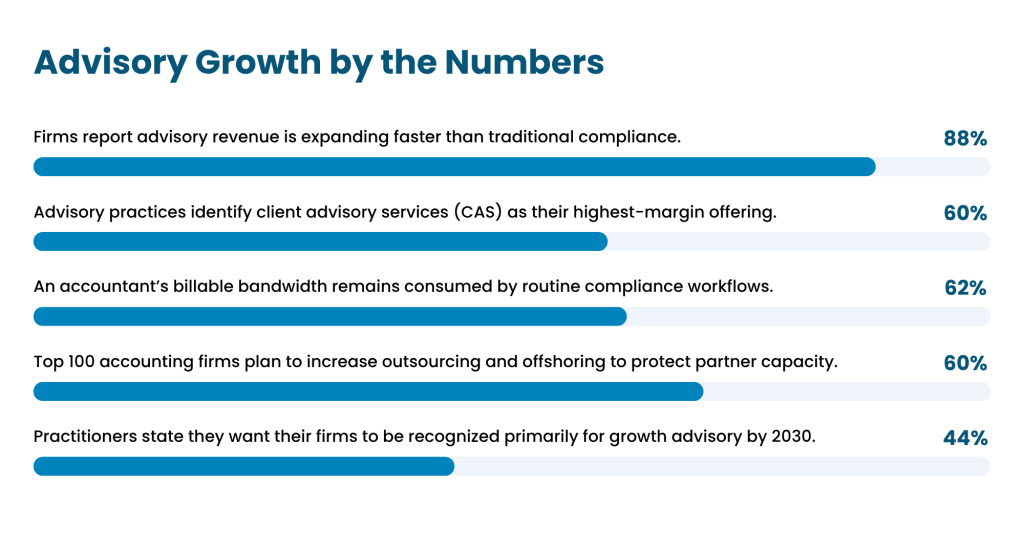
- Advisory is growing faster than compliance: 88% of firms in Thomson Reuters’ 2026 research say advisory revenue is outpacing compliance revenue.
- However, advisory is no longer one service. Instead, it is a set of specialist services, each with its own rules and expertise.
- For most firms, the main constraint is specialist depth, not just staff time.
- As a result, a specialist partner lets an accounting firm launch a new advisory line in weeks instead of months.
From Compliance to Advisory: The Shift Reshaping Accounting Firms in 2026
The fastest-growing accounting firms are no longer trying to be everything to every client. Instead, they are curating high-impact service lines for defined client verticals and building rigorous technical depth around them.
Industry data from Accounting Today’s fastest-growing firms highlight two intersecting trends: an aggressive shift toward client advisory services and deep vertical specialization. Across our work supporting US accounting practices, the underlying driver is clear. Firms that pull ahead build proactive, forward-looking relationships rather than relying on reactive compliance delivery.
For most managing partners, the strategic direction is settled. Accounting firm advisory services command higher margins, insulate against commoditization, and solve the strategic problems business owners actually bring to the table. The real challenge lies in execution.
For most managing partners, then, the strategic direction is settled. Accounting firm advisory services command higher margins, insulate against commoditization, and solve the strategic problems business owners actually bring to the table. The real challenge, however, lies in execution.
The standard playbook advises partners to simply free up their time. While this is necessary, that advice misses the primary structural bottleneck: modern advisory is not a single discipline. In fact, it spans fractional CFO modeling, multi-state sales tax nexus planning, international structuring, and transaction diligence. As a result, a ten-person practice cannot carry full-time onshore specialists for every technical discipline on traditional overhead.
Scaling advisory in 2026 therefore requires solving the capacity and specialization equation together. That is why the firms winning high-value advisory engagements are rethinking how they resource delivery. Specifically, they structure their practices so senior advisors focus on client strategy while scalable operational models handle the heavy technical lift.
What Services Are the Fastest-Growing Accounting Firms Offering in 2026?
The fastest-growing accounting practices have moved past selling standalone annual tax returns. Instead, they bundle compliance into multi-tiered client advisory services that address cash flow forecasting, multi-state tax planning, fractional CFO oversight, and business restructuring.
These firms do not expand their service rosters at random. Their service expansion relies on three distinct operational pillars.
1. Monetizing the Firm’s Most Underutilized Asset: Trust
Few external advisors have the granular visibility of an accounting firm. After all, handling books, payroll runs, and tax filings exposes revenue drivers, owner distributions, vendor dependencies, and net operating margins.
Historically, firms left this data idle, running tax returns once a year and then filing them away. Today, however, leading practices treat this foundational data as the launching pad for proactive advisory. For example, when a firm already maintains clean general ledgers, extending support into rolling cash flow models, nexus evaluations, or pre-liquidity tax planning is a natural next step. In other words, it is not an aggressive sales pitch.
2. Replacing Fragmented Vendor Stacks with Integrated Delivery
Meanwhile, business owners are actively cutting back on disconnected vendor relationships. Coordinating a bookkeeper in one office, an independent tax preparer in another, and an outside business consultant creates blind spots and delays decisions.
Consequently, fast-growing accounting firms win market share by offering an integrated model:
Core Accounting: Real-time general ledger reviews, monthly closes, and management reporting.
Specialized Tax Advisory: Proactive quarterly tax projections, R&D tax credit capture, and pass-through entity optimization.
Strategic Advisory: Scenario modeling, capital expenditure planning, and key performance metric tracking.
Above all, this multi-service architecture drives client retention. When an accounting practice manages both transactional workflows and strategic growth planning, client churn drops significantly.
3. Solving the Delivery Trilemma: Build, Buy, or Partner
Offering higher-margin advisory lines requires direct technical capability. Accounting firm leadership generally faces three paths to build that bench:
Building in-house: Often stalled by the domestic talent shortage and high payroll overhead for specialized roles.
Buying through M&A: Capital-intensive and presents cultural integration hurdles.
Partnering via strategic outsourcing: Using trusted offshore back-office teams to run the compliance and bookkeeping engine.
For mid-sized and regional accounting firms, strategic outsourcing has therefore become the preferred operational lever. Offloading compliance, reconciliations, and routine tax prep to an experienced offshore extension lets senior US accountants protect their bandwidth. As a result, they can master value pricing and deliver the strategic insights high-fee advisory demands.
Why Are Accounting Firm Advisory Services a Top Growth Priority? (2026 Data)
Accounting firm advisory services have shifted from an experimental add-on to the primary revenue engine for forward-thinking firms. The reason is twofold: first, market demand is compounding, and second, advisory engagements yield significantly higher profit margins than transactional compliance.
Recent benchmark studies from Thomson Reuters, INSIDE Public Accounting, and Intuit QuickBooks clearly reflect this transition:
The 62% Capacity Trap: Why Advisory Growth Stalls
Although managing partners recognize the profitability of advisory work, the data reveals an operational disconnect. Firms want advisory margins, yet 62% of practitioner time remains tied up in baseline tax prep and bookkeeping.
Simply put, advisory cannot be delivered on leftover time. When senior accountants spend their workweeks chasing missing W-2s, untangling messy reconciliations, and meeting filing deadlines, high-value advisory conversations keep getting postponed.
Why Top 100 Firms Are Turning to Strategic Offshoring
To break this cycle, 70% of the Top 100 US accounting firms are actively scaling their outsourcing and offshoring infrastructure.
Importantly, these firms are not offshoring to cut corners. Instead, they are doing it to engineer capacity. By shifting backend data entry, routine tax returns, and general ledger reconciliation to dedicated offshore teams, leaders buy back the hours needed for cash flow modeling, strategic tax planning, and virtual CFO guidance.
Without a reliable back-office delivery engine, expanding into CAS risks burning out your core team. With one, on the other hand, firms can move from reactive compliance shops to proactive, high-margin advisory powerhouses.
What Types of Advisory Services Are Clients Searching For?
Clients rarely search for broad labels like general business consulting. Instead, search queries and buyer decisions are driven by immediate operational friction points, such as economic nexus exposure, cross-border entity structuring, or exit readiness.
For this reason, positioning accounting firm advisory services effectively means replacing vague offerings with focused solutions tied to verifiable business outcomes.
Why Problem-Specific Advisory Outperforms Generic Consulting
Announcing that your firm provides advisory services generates little client engagement because business owners cannot determine what they are buying.
Compare two value propositions:
Generic: “We offer strategic advisory services for expanding enterprises.”
Specific: “We help multi-channel e-commerce brands navigate economic nexus thresholds, product taxability, and multi-state sales tax filings.”
The second approach clearly identifies the client and the exact operational problem. It also aligns directly with organic search behavior and AI answer engines matching specific business inquiries with qualified service providers.
High-Demand Advisory Service Lines
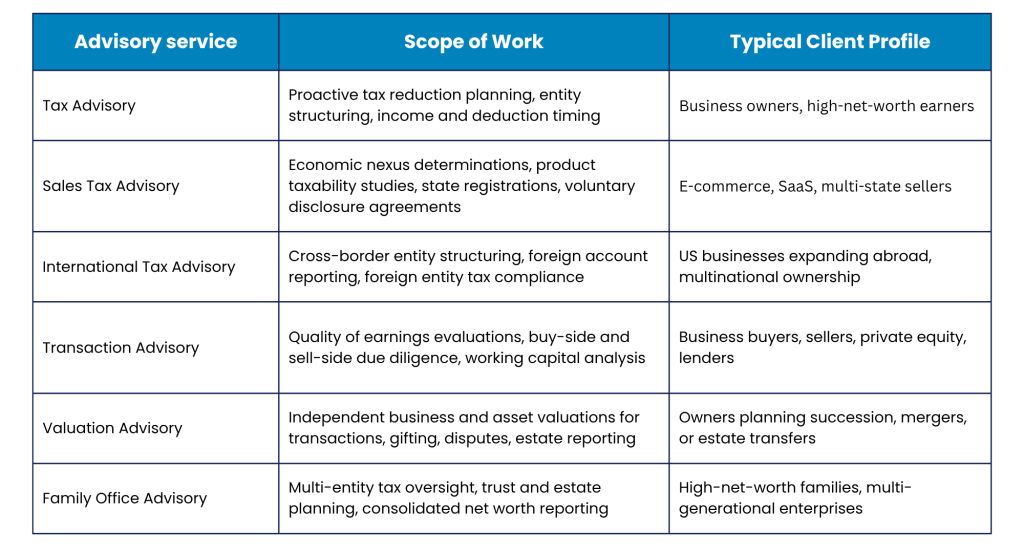
Mapping Client Triggers to High-Margin Advisory
Strategic advisory conversations rarely begin with a cold pitch. They originate when an ongoing client experiences a business transition that triggers a specialized need:

The Operational Challenge for Mid-Sized Practices
While these advisory offerings command premium fees, few regional accounting firms can justify maintaining full-time domestic specialists across every niche.
Fast-growing practices resolve this capacity gap through flexible delivery partnerships. By engaging specialized offshore accounting teams to manage complex filings, multi-state data reconciliations, and background analysis, firms deliver high-tier advisory services without inflating fixed onshore payroll.
See also why industry specialization matters for accounting firms.
What Stops Accounting Firms from Offering More Advisory Services?
The transition toward advisory is rarely stalled by a lack of vision. It stalls because of two operational realities: exhausted partner bandwidth and a shortage of specialized technical depth.
While managing partners recognize advisory potential, daily billable hours remain dominated by reactive compliance and administrative catch-up.
The Two Core Barriers Stifling Advisory Growth
According to the Intuit 2026 Accountant Technology Survey, the top obstacles holding accounting firms back from expanding their advisory engagements are:
Manual Data Cleanup (30%): Outdated client records, incomplete source files, and broken software integrations consume high-value hours before any strategic advisory work can start.
Staffing Shortages (24%): Ongoing recruitment and retention headwinds make it challenging to maintain adequate headcount for core compliance, let alone new advisory initiatives.
Barrier 1: The Bandwidth Deficit (Trapped in the Data Cleanup Loop)
Strategic advisory requires proactive reflection: reviewing rolling 13-week cash projections, evaluating gross margin trends, and modeling scenarios with clients.
However, when senior professionals must spend 30% of their bandwidth untangling disorganized books, reconciling unmapped bank feeds, and chasing W-9s, client review meetings end up delayed. When compliance deadlines loom, advisory initiatives are invariably pushed aside.
Barrier 2: The Specialist Depth Paradox
Even when a firm carves out extra hours, time alone does not solve the advisory puzzle. Advisory is not a monolithic service—it requires granular technical specialization.
A firm cannot credibly offer cross-border advisory without deep, daily familiarity with complex foreign reporting obligations like Form 5471 or Form 8865. Similarly, offering multi-state nexus advisory requires continuous tracking of fluctuating state economic thresholds and marketplace facilitator laws.
For small to mid-sized practices, staffing this specialized bench in-house creates three structural hurdles:
Cost and Scarcity: Experienced tax and transaction specialists command premium salaries, competing directly against national and Big 4 firms.
Uneven Demand: A regional practice might encounter six clients per year undergoing international expansion or M&A diligence—not enough volume to support an onshore six-figure specialist year-round.
Rapid Regulatory Velocity: Sales tax nexus statutes, digital asset reporting rules, and international compliance mandates shift continuously. Infrequently used in-house knowledge quickly becomes obsolete.
The Modern Scaling Framework: On-Demand Technical Depth
Winning accounting firms in 2026 do not attempt to hire full-time domestic specialists for every emerging vertical. Instead, they separate client relationship leadership from technical back-office execution.
By integrating an offshore strategic partner like Infinity Globus, US accounting practices can access specialized capability on demand. Whether your firm needs an outsourced team to run tedious multi-state sales tax reconciliations, support complex cross-border reporting packages, or complete routine monthly closes, a reliable offshore extension gives you the capacity to scale without adding fixed payroll.
Looking to Expand Into Specialized Advisory Without Full-Time Hiring Overhead?
Discover how Infinity Globus’s dedicated accounting and tax teams deliver the operational capacity and technical bench accounting firms need to scale client advisory services sustainably.
Build, Buy, or Partner: How Can Accounting Firms Add Advisory Capabilities?
When accounting firms decide to expand beyond baseline compliance, they face a critical operational question: What is the most viable path to acquire specialized technical advisory capability?
Practices typically evaluate three delivery routes:
Build: Recruiting, onboarding, and training internal specialists.
Buy: Acquiring another practice or book of business through M&A.
Partner: Collaborating with an established external outsourcing and specialist delivery firm.
Understanding the capital requirements, speed, and execution risk of each model is essential before committing firm resources.
Speed-to-Market: Launch Timelines Compared
Partnering with a specialist provider: A few weeks.
Building in-house: Several months (recruiting, vetting, onboarding, training).
Buying through M&A: A year or more (deal sourcing, due diligence, closing, systems integration).
Delivery Models: Side-by-Side Comparison
| Factor | Build (In-House Staffing) | Buy (M&A / Practice Acquisition) | Partner (Dedicated Specialist Provider) |
|---|---|---|---|
| Typical Time to Launch | Several months to recruit, vet, and train | Frequently 12+ months to identify, close, and integrate | Rapid deployment (typically a few weeks) |
| Upfront Capital & Overhead | High: base salaries, benefits, recruiter fees, software seats | Very high: purchase price multiples, legal/deal fees, integration costs | Low to variable: pay for direct execution and capacity delivered |
| Specialist Breadth | Limited: typically 1–2 competencies per hire | Constrained: limited to the acquired firm’s legacy skill sets | Broad: immediate access to deep benches in sales tax, international filings, and CAS |
| Capacity Elasticity | Inelastic: overhead remains fixed regardless of billable volume | Inelastic: fixed corporate overhead and payroll debt | Highly elastic: scale hours and team size dynamically with demand |
| Downside Risk | Underutilized bench and non-billable salary drag | Depreciating acquired goodwill and costly cultural mismatch | Low: minimal fixed liabilities if client demand fluctuates |
| Optimal Strategic Fit | High-volume, repeatable, year-round core engagements | Entering a geographic territory or capturing significant market share rapidly | Launching, testing, and scaling new or variable advisory service lines |
How Forward-Thinking Firms Combine All Three: The Staged Growth Model
These three delivery avenues do not have to be mutually exclusive. In practice, the fastest-growing accounting firms employ a staged capability framework:
Test & Validate (Partner): When clients begin asking for specialized help—such as multi-state sales tax nexus studies or cross-border entity structuring—the firm partners with a dedicated outsourcing provider like Infinity Globus. This allows leadership to offer the service immediately, validate genuine willingness to pay, and refine pricing models without incurring six-figure payroll overhead.
Standardize Workflows: The offshore team manages the analytical legwork and complex compliance schedules, while domestic partners lead the strategic client discussions and presentation of findings.
Internalize Only at Scale (Build): Once annual engagement volume in that specific discipline becomes predictable, stable, and high-volume, leadership can decide whether bringing a dedicated full-time onshore specialist makes financial sense.
This staged approach eliminates speculative hiring risk. It enables accounting practices to capture high-margin advisory engagements today, secure client retention, and protect partner profitability without gambling on unproven domestic overhead.
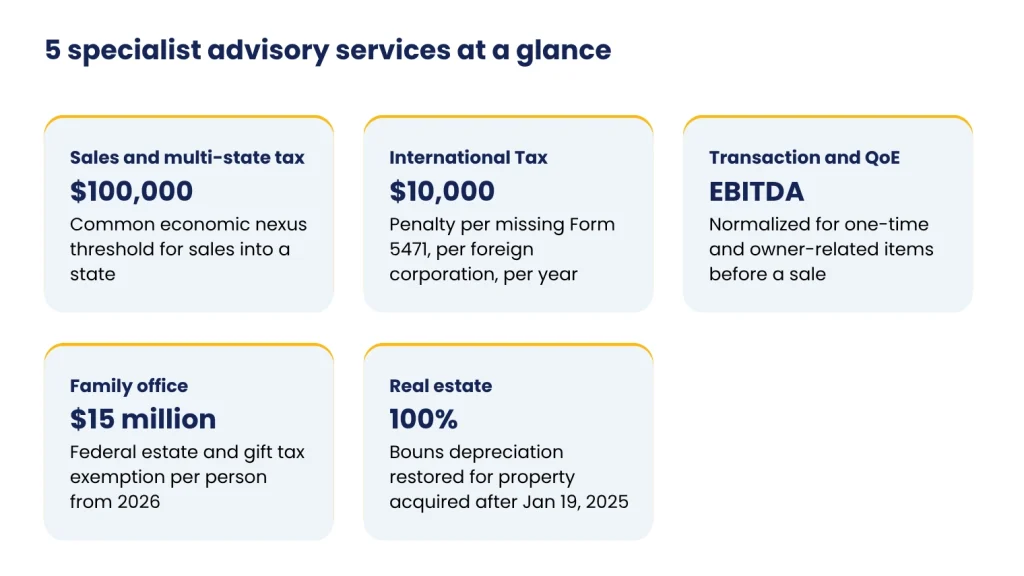
5 Specialist Advisory Services Accounting Firms Can Add in 2026
The strongest commercial opportunities in 2026 lie in specialized technical solutions targeting acute client triggers. Expanding into these five service lines enables accounting practices to capture high-margin advisory engagements while utilizing dedicated offshore teams to handle back-office execution.
1. Sales and Multi-State Tax Advisory
The Client Friction Point: Under the precedent set by South Dakota v. Wayfair, states enforce economic nexus standards regardless of physical storefronts. Most states apply a $100,000 sales threshold, while large jurisdictions like California and Texas use $500,000. With 45 states and Washington, D.C. imposing sales tax, rapidly growing e-commerce merchants and SaaS platforms frequently accumulate significant unmonitored tax liabilities.
The Advisory Offering: Economic nexus studies, product and SaaS taxability analyses, exposure modeling, voluntary disclosure agreements, and comprehensive multi-state mitigation planning.
The Delivery Engine: Tracking dynamic state-by-state thresholds, jurisdictional transaction reconciliations, liability calculations, entity registrations, and recurring multi-state filing packages.
2. International Tax Advisory
The Client Friction Point: Operating entities and individuals maintaining cross-border subsidiaries, foreign accounts, or international ownership encounter aggressive reporting penalties. The IRS enforces strict statutory assessments even where zero underlying tax is due: failing to file Form 5471 carries a baseline $10,000 annual penalty per foreign corporation, while Form 5472 non-compliance incurs a $25,000 penalty per violation.
The Advisory Offering: Cross-border entity structuring, pre-expansion reviews, transfer pricing strategy, passive foreign investment company analysis, and missed filing remediation.
The Delivery Engine: Preparation of specialized informational filings, including Form 5471 for foreign corporations, Form 5472 for foreign-owned domestic entities, Form 8865 for foreign partnerships, Form 8858 for disregarded entities, Form 8938 for specified foreign assets, and FinCEN Form 114 filings for aggregate offshore accounts exceeding $10,000.
3. Transaction Advisory and Quality of Earnings Support
The Client Friction Point: During an acquisition, debt financing, or recapitalization, buyers and capital providers rigorously assess underlying cash flows. Undocumented owner add-backs or disorganized ledgers erode deal multiples and introduce closing friction.
The Advisory Offering: Sell-side exit preparation, buy-side due diligence, net working capital peg setting, and Quality of Earnings analysis to normalize earnings before interest, taxes, depreciation, and amortization.
The Delivery Engine: Financial statement recasting, EBITDA bridge schedules, transaction revenue-to-deposit reconciliations, working capital tracking, and virtual data room curation.
4. Family Office Advisory
The Client Friction Point: High-net-worth families manage assets fragmented across operating companies, holding entities, family trusts, private funds, and real estate partnerships. Compounding this complexity, estate and wealth transfer strategies require proactive planning around the permanent $15 million per individual federal estate and gift tax basic exclusion amount under the One Big Beautiful Bill Act.
The Advisory Offering: Consolidated balance sheet reporting, multi-generational liquidity modeling, lifetime gifting advisory, and multi-entity tax structuring.
The Delivery Engine: Multi-entity monthly consolidations, private investment bookkeeping, trust tax returns on Form 1041, partnership filings on Form 1065, and federal gift tax returns on Form 709.
5. Real Estate Advisory
The Client Friction Point: Commercial syndicators, builders, and real estate funds require clean entity-level financial reporting and proactive tax engineering. Maximizing capital allowances is essential following the permanent restoration of 100% bonus depreciation for qualifying assets placed in service after January 19, 2025, under the One Big Beautiful Bill Act.
The Advisory Offering: Portfolio structuring, cost segregation planning, and 1031 like-kind exchange coordination, ensuring strict adherence to the 45-day replacement identification and 180-day acquisition deadlines.
The Delivery Engine: Property-level bookkeeping, multi-tier partnership allocations, Schedule K-1 production, fixed-asset depreciation schedules, and investor waterfall reporting.
Scaling Advisory Without Increasing Fixed Payroll
These practice areas illustrate an important principle: accounting firms do not fail to offer advisory because they lack client interest; they fail because they lack delivery bandwidth.
By teaming up with Infinity Globus, US accounting practices access an experienced offshore delivery engine that handles data analysis, reconciliations, and reporting behind the scenes. This enables senior accountants to focus their billable hours where they generate the highest returns: delivering high-value advisory insights directly to clients.
How to Launch Advisory Services at Your Accounting Firm: A 5-Step Roadmap
Transitioning from compliance delivery to recurring advisory work does not require overhauling your entire client base at once. Leading accounting practices launch client advisory services through a structured rollout that preserves partner bandwidth and protects realization rates.
Here is a 5-step operational blueprint to launch and scale advisory services:

Step 1: Mine Your Existing Client Base for High-Value Triggers
Do not hunt for new advisory clients cold. Your current client ledger already contains unaddressed advisory needs. Conduct a focused portfolio review looking for operational events:
E-Commerce and Digital Retail: Clients crossing multi-state revenue or transaction counts indicating sales tax nexus exposure.
International Footprints: Domestic entities reporting foreign bank accounts, offshore vendors, or international subsidiaries.
Founder Transitions: Business owners nearing retirement, exploring succession planning, or contemplating an exit within the next 24 to 36 months.
Real Estate Accumulation: Commercial or multi-family investors needing 1031 exchange planning and cost segregation support.
Step 2: Choose 1 or 2 Focus Niches
Avoid launching a generic business consulting practice. Focus on one or two service lines where your existing client roster shows clear demand. Starting with a focused offering like multi-state sales tax compliance or fractional CFO cash flow advisory delivers distinct advantages:
Standardizes internal review workflows and data gathering.
Makes your core value proposition clear to clients.
Minimizes operational friction across your production team.
Step 3: Package, Scope, and Price for Value
Advisory engagements billed by the hour inevitably commoditize your expertise. To preserve strong realization rates, shift to value-based or fixed monthly subscription models:
Define Concrete Deliverables: Outline the scope in your engagement letter, detailing deliverable frequency, report types, monthly check-in cadences, and client turnaround requirements.
Establish Clear Scope Boundaries: Explicitly define where baseline advisory ends and ad-hoc transaction support begins to protect against scope creep.
Tier Your Service Offerings: Present three distinct service tiers, such as Core Compliance, Strategic Advisory, and Comprehensive Virtual CFO, letting clients choose their preferred level of strategic support.
Step 4: Lock In Specialist Delivery Capacity Before Selling
Selling an advisory engagement before confirming your delivery team creates immediate bottlenecks. Decide upfront whether to build, buy, or partner:
Avoid burdening senior partners with manual reconciliations, lead schedule prep, or multi-state return filings.
Establish a dedicated offshore extension with Infinity Globus to handle backend accounting, cleanups, and complex schedules.
By locking in reliable delivery infrastructure first, your onshore team can step directly into high-value client advisory conversations without risking delivery delays.
Step 5: Run a 90-Day Pilot, Refine, and Scale
Roll out your packaged advisory offering to a select group of 5 to 10 existing clients who already know and trust your team. Use this pilot phase to fine-tune your delivery:
Refine Workpaper Handoffs: Iron out communication cadences between your client managers and your backend delivery team.
Track Key Practice Metrics: Measure average revenue per client, realization rates, and client satisfaction scores.
Standardize and Scale: Use feedback and case studies from the pilot cohort to train your wider team, market the service across your remaining book of business, and introduce your next specialist advisory line.
How Infinity Globus Supports Accounting Firm Advisory Services
Infinity Globus serves as a dedicated delivery engine for forward-thinking accounting firms, enrolled agents, and accounting practices across the United States. We eliminate the operational bottlenecks that prevent practices from scaling, providing the technical bench required to deliver high-margin client advisory services without domestic hiring overhead.
Partnering with Infinity Globus provides your practice with distinct operational advantages:
On-Demand Specialist Benches: Access technical teams across multi-state sales tax nexus analyses, complex cross-border informational filings, transaction Quality of Earnings workpapers, multi-entity family office reconciliations, and commercial real estate cost segregation data prep.
Qualified Technical Bench: Engagements are executed by qualified accounting professionals and IRS Enrolled Agents, directed by senior practice leaders with extensive experience in US GAAP and federal tax compliance.
Centralized Delivery & Rigorous Review: Standardized production workflows and multi-tier quality checks ensure every workpaper arrives formatted, referenced, and ready for partner sign-off.
Flexible Engagement Architecture: Scale capacity around your firm’s specific growth timeline. Whether piloting a single client file or embedding an offshore pod across your entire CAS division, our engagement models adapt to your practice.
Institutional Security & IRS Compliance: Workflows are structured around strict data protection protocols, including full adherence to IRC Section 7216 taxpayer disclosure standards, multi-factor authentication, role-based system access, and secure remote environments.
Whether your practice is launching its first advisory service tier or expanding specialized divisions across multiple verticals, Infinity Globus delivers the operational capacity and technical depth needed to say yes to more advisory opportunities.
Build a specialist bench for your firm with Infinity Globus and start saying yes to more client needs.
Frequently Asked Questions About Accounting Firm Advisory Services
1. What are accounting firm advisory services?
Accounting firm advisory services are forward-looking services that help clients make better financial and business decisions. Unlike compliance work, which reports on the past, advisory work shapes future outcomes. Examples include tax planning, sales tax advisory, international tax advisory, transaction support, cash flow forecasting and virtual CFO services.
2. What is the difference between compliance and advisory services?
Compliance services meet legal and reporting obligations, such as preparing tax returns, financial statements and payroll filings. Advisory services use financial information to guide decisions, such as how to structure a business, reduce future tax or prepare for a sale. Advisory work is usually recurring and commands higher fees.
3. What advisory lines are top accounting firms prioritizing in 2026?
The fastest-growing accounting firms are packaging compliance into integrated client advisory services for focused industry verticals. Priority lines include multi-state economic nexus compliance, cross-border tax advisory, outsourced controllership, scenario modeling, and transaction support, including sell-side Quality of Earnings reviews.
4. Can a small accounting firm offer international tax advisory?
Yes. Mid-sized practices regularly provide high-tier cross-border advisory by pairing their senior client relationships with an experienced offshore delivery partner. The firm’s partners lead the client consultations and planning, while the outsourcing partner handles complex informational return preparation, including IRS Forms 5471, 5472, and 8865. This allows smaller practices to capture lucrative international engagements without carrying full-time domestic overhead.
5. How do accounting firms move from compliance to advisory?
The most reliable transition path follows a five-stage operational framework:
Audit your existing client base for advisory triggers like multi-state sales or foreign accounts.
Select one or two distinct specialties rather than pitching generic advice.
Package and price the service using fixed monthly retainers or value pricing instead of hourly billing.
Secure back-office delivery capacity upfront through an external outsourcing partner.
Pilot the service with 5 to 10 trusted clients before rolling it out across your entire practice.
6. How does Infinity Globus help accounting firms offer advisory services?
Infinity Globus acts as an on-demand technical delivery engine for US accounting firms, enrolled agents, and accounting practices. We provide dedicated back-office capacity across sales and multi-state tax, cross-border IRS reporting, transaction due diligence, Quality of Earnings preparation, real estate accounting, and recurring bookkeeping. By offloading complex production schedules and compliance work to our team, US partners reclaim the hours needed to lead high-margin strategic advisory relationships.
Get in touch
